
Days of Punk
| Fashion
Post Punk: When Punk Turned Experimental
Posted by Michael Grecco

Post Punk: When Punk Turned Experimental
The initial explosion of Punk as an evolution of rock n’ roll was discounted by the entrenched corporate powers that pushed music as a profit product. The overproduced rock hierarchy, its corporate, shareholder-driven profit margins, and its disconnection from a generation drove the birth of Punk.
Hatched in suburbia and gentrified urban landscapes by the disaffected who scorned the homogenization of society in art, music, fashion, and indeed life itself, Punk was born of frustration, rebellion, and the will to interrupt rock’s death spiral. Once the music of revelation, revolution, and exploration rock.
Corporations had main-streeted the music. Rock was the music of supermarkets, malls, and civic arenas. Political campaigns latched onto rock theme songs, further fermenting the fire in the souls of the disaffected who created a new sound, a new culture, a new art with the birth of Punk.
The initial explosion of basic music that favored speed, simplicity, attitude, and a DIY ethos cast aside commercial success. The word, culture, and music of Punk became cemented into music as an accepted genre. Once the dust had settled from the initial implosion of Punk, the question became, “Where do we go from here?” The answer was Post Punk, when Punk turned experiential.
Art, Experimentation, Mood, Atmosphere and Punk
Post Punk did not abandon the essence of the DIY ethos, its simplicity, its antisocial fervor, its quest for a music of the people. Post Punk expanded the three-chord structure from the birth of Punk. It incorporated the unconventional. Hypnotic bass, driving drums, unconventional guitar patterns and sounds. Synthesizers and rhythms provided the inspiration for darker lyrical themes, performance art that mixed unsettling, intellectual, mysterious, and danceable avant-garde music.
Siouxsie and the Banshees
Siouxsie and the Banshees, formed in the early Punk explosion of London, quickly grabbed the reins of Post-punk leaders. Rather than wait on the change, Siouxsie and the Banshees, developed an atmospheric sound that was grounded in Punk. The distinctive vocals of lead singer Siouxsie Sioux provided a dramatic intensity that hung over the band’s evolving guitar work. The vocals shifted effortlessly from icy early Punk restraint to dramatic Post-punk performance intensity.

Siouxsie and the Banshees photographed by Michael Grecco
The early aggression of Punk from the early founding bands such as The Ramones came from speed, volume, and discombobulation. The Banshees, as they came to be referred to, created a haunting musical landscape for the vocals of Siouxsie Sioux with tension, repetition, space and mood, equally powerful as a sound of early Punk.
The Mechanics Of Industrial Post Punk
Punk was set against a societal background that measured success by production. It was the second Industrial Revolution, mechanizing and computerizing a society measured by production. Killing Joke, another early London Punk pioneering band, grabbed the industrialized textures and used heavy rhythms to create a post-punk ominous atmosphere that combined the primitive and the future. Killing Joke absorbed the early pounding percussion and the repetitive guitar work of early Punk while overlaying industrial music with electronic experimentation, creating a post-punk that maintained the essence of disaffection as expressed by early Punk.

Killing Joke photographed by Michael Grecco
Performance Punk
Punk and art collided and emerged in a US band, Talking Heads. Frontman David Byrne took Post Punk to the theater. The Talking Heads were musically adept performers. Musically the sound was minimalist funk, laid over African rhythms, cloaked in experimental compositions, told in the dramatic style of performance art. The Talking Heads connection to early Punk was the rejection of commercial convention. David Byrne as an art major was not steering the band to the volume of Punk but rather to is core of completely constructing a song in a different way.
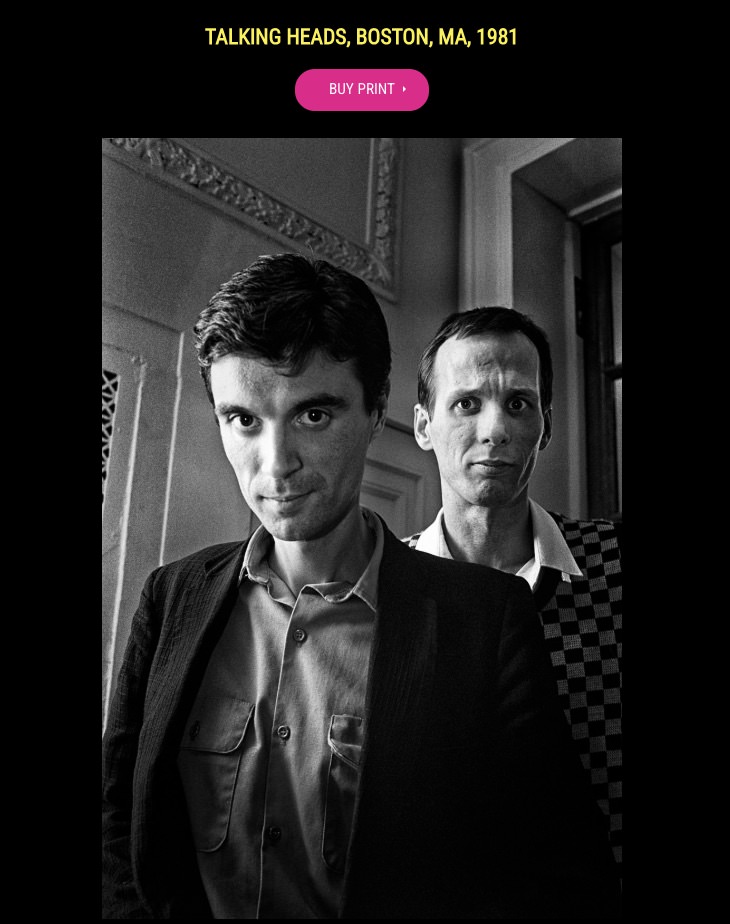
Talking Heads photographed by Michael Grecco
Post Punk Lives in an Evolving New Order
Tying together influences of Post Punk, New Order formed in Manchester, England blazed a trail that continues to be explored and recognized as Post Punk. Tying together and reinventing the sounds forged by Siouxsie and the Banshees, Killing Joke, Talking Heads and others, New Order fused a fascinating space between post-punk melancholy and electronic pop. New Order showed Punk, synthesizers, sequencers, drum machines, and dance-music influences.
The post-punk era continues today. The Punk of suburbia, and the decaying urban landscapes of the late 1970s hatched the spirit of Punk, it continues to grow and evolve in the experimental music of today.
